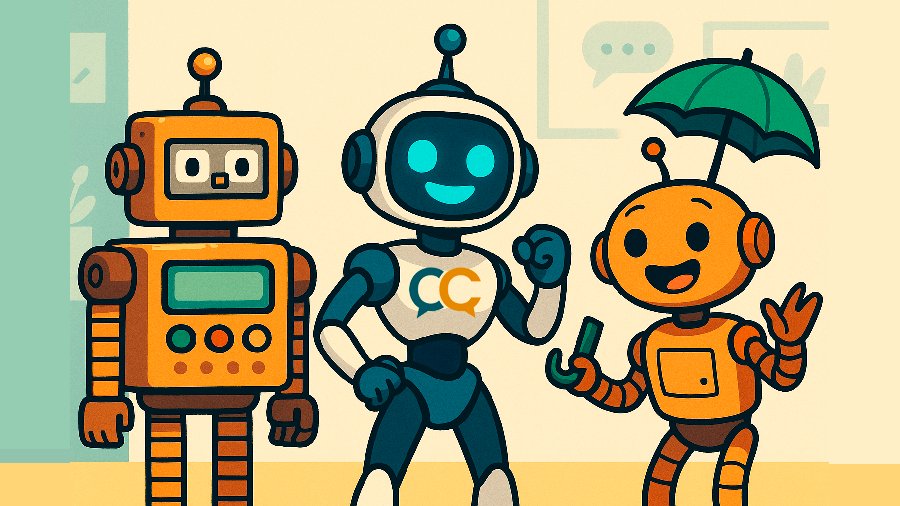
Those chat interfaces that force users to choose between numbered options—“press 1,” “type A,” “select from the menu”—are not conversing. They are reproducing a closed structure, closer to a static website than a dialogue.
The interface is a chat, but the logic is not.
That is why, when someone attempts to step off the predefined path, the system fails to respond. Not because it is broken, but because it was never designed to interpret anything outside that rigid framework.
The issue is not simplicity
A script-based chat interface without AI can fulfill its function remarkably well. It operates with organized data, does not improvise, and maintains absolute consistency. In certain processes, that is precisely what is required.
The critical friction appears elsewhere: in how the effort of the interaction is distributed.
When the system lacks interpretation capacity, the client must do the heavy lifting. They have to translate their specific need into the available choices, test different paths, and backtrack. The outcome is predictable: frustration, lost time, and, frequently, abandonment.
This is not a technical failure. It is a design decision.
When AI enters, the problem shifts
AI-driven interfaces promise the exact opposite: natural language comprehension, flexibility, open-ended responses.
And in many instances, they deliver.
However, they also introduce a different kind of risk, because fluent execution is not the same as operational interpretation. A system can write flawlessly and still completely misread the situation.
This is where responses appear correct but are fundamentally flawed. They might blend disparate data or confidently charge down the wrong path.
The flaw is no longer rigidity. It is a lack of judgment.
The trap of "apparent intelligence"
In practice, this creates a frequent paradox.
Significant time is spent carefully structuring non-AI interfaces: workflows, options, validations. Everything is mapped out because there is no room for interpretation.
Conversely, when AI is introduced, many implementations lean entirely on the model's ability to "solve" things on its own—as if understanding language were synonymous with making sound decisions. It is not.
Without a clear mechanism to interpret context, evaluate the situation, and determine the appropriate response, the system remains exposed to errors that may not be obvious initially but directly erode the client experience.
Judgment and logic for handling business operations. Whether you are facing a concrete operational friction or simply exploring possibilities, input a real work scenario and take it from there.
Analyze your case →Where the experience truly breaks down
In both scenarios—with or without AI—the breakdown occurs when the system cannot sustain a coherent interaction logic when facing real-world situations.
- In the rigid interface, everything unforeseen is left out.
- In the AI interface, whatever is misinterpreted is answered anyway.
In one case, the client makes no progress. In the other, they progress in the wrong direction.
This leads to concrete consequences: unresolved inquiries, poorly assisted decisions, and commercial opportunities lost without any clear visibility as to why.
What distinguishes systems that actually work
When a conversational system begins to deliver consistent responses across variable contexts, it is not because of the underlying model. It is because there is a layer organizing the situation prior to generating a response: it interprets what is occurring, what the individual requires, what information is relevant, and only then determines how to intervene.
This architecture is invisible from the outside, but it is what sustains the conversation when it ceases to be linear.
A less visible, yet more decisive outcome
- A well-structured interface without AI can handle well-defined workflow scenarios without friction.
- A well-designed AI interface can adapt without losing coherence.
The difference lies not in one "being smarter" than the other, but in how the responsibility of understanding the situation is distributed.
- When that responsibility falls on the client, the experience suffers.
- When it stays within the system, but lacks a clear framework for interpretation, the issue becomes less apparent but far harder to detect.
Therefore, rather than choosing between AI or no AI, the strategic question is: Is our online assistant equipped to interpret the situation before it attempts to respond?