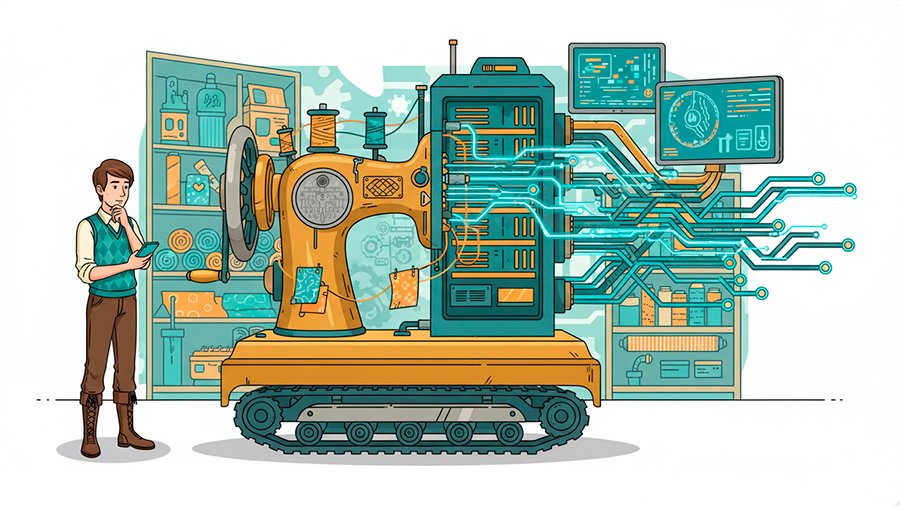
AI didn’t arrive to replace you. It came to give you your time back.
The line sounds reasonable. It also reassures. That is precisely the issue.
A role doesn’t need to disappear for replacement to begin. The shift starts earlier, quietly, when parts of the work stop requiring your intervention. The role remains, but it is gradually hollowed out from within.
That distinction matters for companies assessing AI adoption. The focus tends to be on jobs, while the real change happens at the level of tasks.
When replacement is not visible
In 1830, Barthélemy Thimonnier patented the first sewing machine. A decade later, he ran a workshop with dozens of machines producing uniforms for the French army. One night, a group of tailors destroyed everything.
They were not reacting to mass layoffs. They were reacting to something harder to accept: a tool that was making parts of their work unnecessary.
The craft did not disappear. It changed. Output increased, costs dropped, new workshops emerged, and more people worked in the industry than before. But not under the same conditions, and not doing the same work.
That pattern repeats today.
The mistake of evaluating AI as a direct threat
In many companies, the discussion around AI reduces to efficiency gains or job impact. That framing misses what is actually happening: tasks reorganize before any visible effect on roles.
In practice, the shift is gradual. First, fragments are automated: simple inquiries, order classification, standard messages. Then those fragments begin to connect. In that process, certain tasks stop justifying constant human intervention.
The outcome is not necessarily less work, but a different distribution of it. And that redistribution is not neutral: it requires decisions.
When the issue becomes operational
Task displacement is not new. Companies have always faced it, and successful adaptations have always depended on sound judgment. If the issue is not displacement itself but how it is handled, what is different now is the speed. The pace of change is outstripping the pace at which companies develop the necessary judgment.
Problems emerge when displacement is implemented without criteria. Automating responses does not ensure those responses make sense in context. Delegating simple decisions to a system does not mean it is interpreting the situation correctly. When these fail, the impact is not technical; it is commercial.
Misplaced responses, stalled processes, customers receiving correct information at the wrong time. These are not obvious failures, but accumulated inconsistencies. At that point, the question is no longer whether AI replaces work, but whether the system understands what is happening before it acts.
Judgment and logic for handling business operations. Whether you are facing a concrete operational friction or simply exploring possibilities, input a real work scenario and take it from there.
Analyze your case →Working differently is not optional
Every technological shift leaves one group displaced and another that adapts. The difference is not in adopting the tool, but in understanding its role within the process. With AI, that role is not just executing tasks faster, but intervening in decisions that previously required human interpretation.
When that interpretation is not defined, the system still responds. It does so without judgment.
This is where many implementations fail: not due to model limitations, but due to the absence of a logic that determines what to do in each situation.
Resistance does not change the outcome
The tailors who destroyed the machines did not stop industrial sewing. They simply removed themselves from the process. Today there are no burned workshops, but there are subtler forms of resistance: delaying decisions, waiting for external clarity, assuming the impact will be limited.
Meanwhile, adoption continues. Not uniformly, but steadily.
The issue is not whether AI will integrate into daily work. It already is. The issue is under what logic it integrates.
What actually changes
Work does not disappear. It reorganizes. Some tasks no longer require intervention, others emerge. In between, a layer becomes explicit that was not before: deciding how a situation is interpreted before responding.
That layer determines whether a system adds value or creates friction. The question is not whether to use AI, but what role it plays in the process and under what criteria it operates.
Because replacement does not arrive all at once. It begins when parts of the work stop needing you. What determines the outcome is not that this happens, but the logic used to interpret and decide what to do in each case.