The promise of free time that never shows up
“AI is here to give you your time back.” The phrase spreads easily because it fits a familiar expectation: that work is something external, almost a burden that could be reduced without consequences.
In practice, that assumption does not hold. The time compressed today by AI does not remain available for long. It gets absorbed—and not necessarily by the one who freed it.
The issue is what happens next
Current systems do reduce task time: they draft, summarize, respond. But that same effect is available to every other player in the market.
When a company shortens a task, it does not gain “free” time. It enters a dynamic where others do the same. The advantage goes to whoever is better organized, applies stronger judgment, or extends further. The real issue is how it is integrated into actual work.
The operational nap
If automation is treated as a way to ease off—doing the same with less effort—the effect is immediate but short-lived. Other companies will use that same time gain to review processes more carefully, expand coverage, improve response quality, or sustain longer conversations without losing consistency.
The difference is not technological. It is applied judgment.
Judgment and logic for handling business operations. Whether you are facing a concrete operational friction or simply exploring possibilities, input a real work scenario and take it from there.
Analyze your case →When novelty stops impressing
Early interactions with systems like ChatGPT generated genuine surprise. The sense that a machine “understands” shifted expectations of what is possible.
That effect is gone. Today it is easy to detect when a response is generic, when it repeats known patterns, or when it cannot sustain an idea beyond a correct sentence. The standard has risen; what used to be sufficient now falls short.
The noise that accumulates
Mass content production with AI has a side effect: it increases the volume of responses that add nothing new. Texts that appear correct but say nothing specific begin to occupy the same space as spam: present, but disregarded.
This directly impacts commercial areas, customer support, and demand generation. Speed alone is no longer enough; the response must make sense within the specific context.
Where AI actually changes outcomes
AI does not turn a company into something it is not. It does not give judgment to a team that lacks it. It amplifies what already exists. If there is clarity, it accelerates progress; if there is unresolved ambiguity, it replicates it at scale. If there is judgment, it extends it. If not, it replaces it with average-fit text—aligned with generic companies, not with your own.
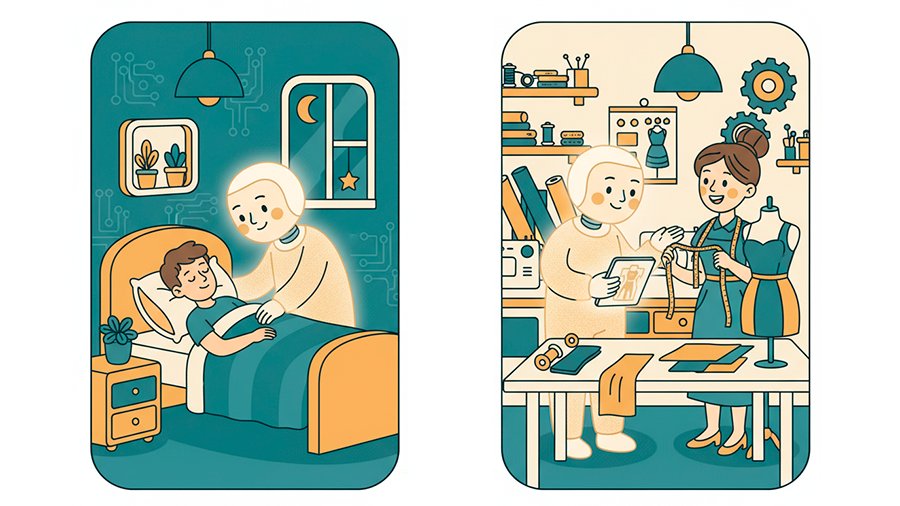
A surgeon with AI does not become a better tailor, nor does a tailor with AI perform better surgery. Specialization remains the differentiator. The tool does not change that. It amplifies it—either with distortion or without it. The more distortion, the more your differentiation erodes, and the more AI pushes you toward being indistinguishable.
What changes when it is properly integrated
When automation goes beyond generating text—when it interprets situations, maintains context, and determines how to respond—the effect shifts. It becomes possible to sustain useful conversations without constant intervention.
In this scenario, time is not “freed.” It is reorganized. This allows more cases to be handled without losing coherence, preserves judgment across repetitive interactions, and reduces rework caused by misaligned responses.
This outcome does not depend on the base model—whether OpenAI, Anthropic, or others—but on how the logic that interprets each situation is structured before any response is produced.
Time does not disappear—it changes hands
The idea that AI gives time back is appealing because it suggests improvement without cost. In practice, that time returns to the system as better-organized competition.
The difference is not how much time is saved. It is what is done with that gain. And that is not defined by the technology—it is defined by how it is integrated into real work.