Not everything that looks like a conversation is just a conversation
An AI-driven chat interface operates, in essence, as an automation. It receives a message, interprets it, and responds without human intervention. From the outside, it appears conversational, but operationally it is a process: input, interpretation, decision, output.
That distinction matters: what makes it valuable is not that it “talks,” but that it can interpret what it receives and decide how to respond in context.
The same structure exists elsewhere in a company. When a client sends an email to request pricing or check availability, the underlying logic is nearly identical. The channel changes, not the process. There is a message, someone interprets it, and someone responds.
The problem begins when that interpretive capability is assumed to be confined to chat.
The limitation of reducing everything to responses
When automation is reduced to answering messages, many of the processes that create real operational load remain untouched.
While teams focus on improving a chat interface, routine manual work continues:
- data copied from a form into an internal system
- reports assembled from scratch every week
- duplicated spreadsheets that never fully align
- incoming claims sorted and distributed manually
None of these are conversations in a strict sense, yet they all follow the same pattern: information that must be interpreted before deciding what to do.
Judgment and logic for handling business operations. Whether you are facing a concrete operational friction or simply exploring possibilities, input a real work scenario and take it from there.
Analyze your case →The same problem in different formats
Look closer and many of these tasks share a common structure:
- they receive information from some channel
- they require interpretation in context
- they involve deciding what to do with that information
- they end in a concrete action
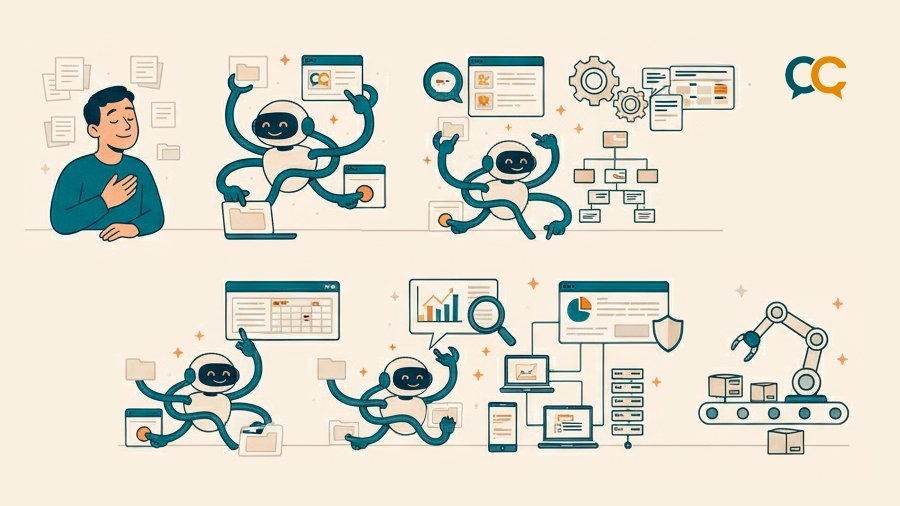
A chat interface resolves this cycle within a conversation. The same cycle can be applied to:
- classifying claims and routing them correctly
- consolidating dispersed data into a single dashboard
- detecting meaningful shifts in metrics and triggering alerts
The difference is not whether there is a conversation, but whether there is an interpretive layer before action.
Where implementations tend to break
When AI is introduced without that layer of judgment, a recurring pattern appears: the response is automated, but the decision is not.
At first glance, the system seems to work—automated replies, basic integrations, functional flows. But the underlying operational issue remains. It simply shifts form:
- data arrives, but not always in the right place
- reports exist, but fail to reflect what actually matters
- automated classifications break down in ambiguous cases
In these scenarios, the system responds, but does not fully interpret what is happening. That distinction determines whether automation truly reduces workload or merely displaces it.
Automating with judgment, not by channel
Meaningful improvement occurs when automation is no longer treated as a standalone tool—a chat interface, a triggered email, an isolated integration—and instead is approached as a system that interprets situations and acts accordingly.
This requires a step before any response is generated—whether in chat, email, or internal workflows—where the system determines:
- what is actually happening
- which information is relevant
- what action is appropriate in that context
When that logic is well designed, the channel becomes secondary. Conversation is just one format through which that interpretive capacity is expressed.
What changes when the process is resolved
At that point, the outcome aligns with what companies seek from a well-designed interface, but applied across operations:
- less manual intervention in repetitive tasks
- reduced dependence on operating hours
- greater consistency in handling similar situations
Each process executed correctly without intervention does more than save time. It reduces errors and frees the team for work that genuinely requires human judgment.
Automation stops being about responding faster and becomes about interpreting better to operate with consistency.