The Paamul Travel case
Paamul Travel Service is a wholesale travel agency with more than 25 years in the Argentine market. Its main site, paamul.com.ar, handles travel packages to Mexico, Central America, and South America: pricing, hotel descriptions, itineraries — everything is updated from a proprietary back office. Érica has been in charge of this for years, and she does it very well.
When they decided to open the English-speaking market, the first idea was to build paamultravel.com in English. But that meant duplicating almost everything: loading the same information twice, maintaining two websites, and adding work hours or staff. Walter, the director, put it plainly: I don’t want this to complicate our daily operations.
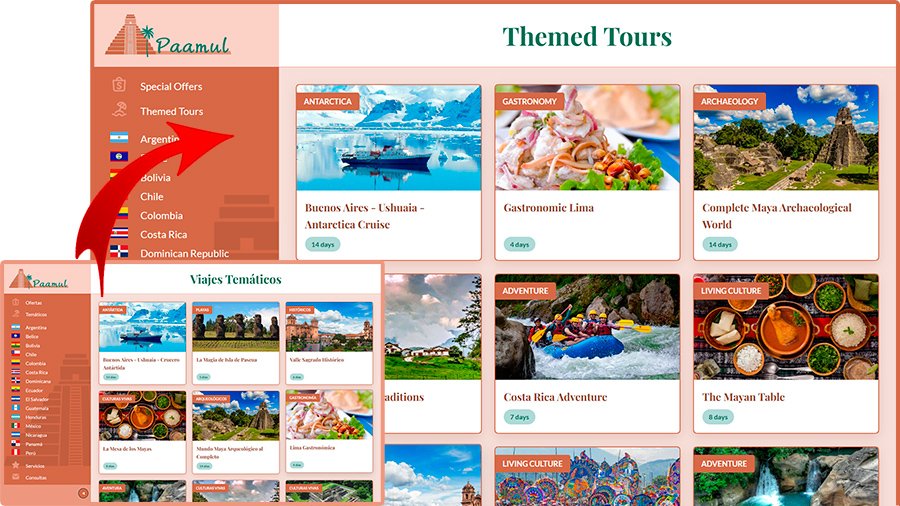
The solution we built at ConverseCraft was different: making the English site a derived “view” of the main one, without duplicating maintenance effort.
How it works in practice
The Spanish site remains the single source of truth. Érica creates or updates a package, a price, or a description exactly as she always has. She doesn’t touch anything extra: no new buttons, no additional fields, no different workflows.
When she publishes a change:
- paamul.com.ar is updated immediately.
- The system detects which parts need translation, because the information is properly separated between structured data (prices, days, cities, codes) and editorial text.
- What does need translation (descriptions, titles, general conditions) goes through an AI module with project-specific prompts we designed: it knows not to alter proper names, respects Paamul’s commercial tone, uses standard tourism terminology in English, and preserves the site’s existing positioning (for example, avoiding literal translations that would hurt SEO).
Publishing to paamultravel.com is automatic in the vast majority of cases. But it’s not completely blind: there’s an option for a quick review by Malena (a bilingual freelance editor with tourism experience) only when the change warrants it — for instance, very long texts, sensitive promotions, or stylistic adjustments they want to review manually.
Result: 80–90% of updates go live in English with no human intervention. The rest are handled quickly, without disrupting Érica’s daily workflow or adding permanent tasks.
Automation without removing people
The goal was never to replace anyone. We still rely on Érica’s expertise for the original content and on Malena’s judgment when context or commercial nuance matters more than speed. AI takes care of the repetitive and mechanical work; people contribute judgment where it actually makes a difference.
What they gained (beyond the tourism case)
- A single team and a single update process.
- Two markets (Spanish- and English-speaking) served without synchronization issues.
- Fewer errors caused by outdated versions.
- Scaling to more languages in the future doesn’t require growing the operational structure at the same rate.
The English site is no longer “another project.”
It’s an almost automatic extension of the work they were already doing.
The takeaway for other SMBs
Many ideas get stalled because we think: “this will mean more maintenance, more people, more recurring costs.”
That’s not always the case.
With proper information segmentation and automation designed for a specific use case, the marginal cost of serving a new market can drop significantly. Not to absolute zero — there’s always an initial investment and some human oversight — but enough to make it worth trying.
At Paamul, growth didn’t mean working more.
It meant working smarter.
Technology used to remove complexity, not to add another layer.
Judgment and logic for handling business operations. Whether you are facing a concrete operational friction or simply exploring possibilities, input a real work scenario and take it from there.
Analyze your case →