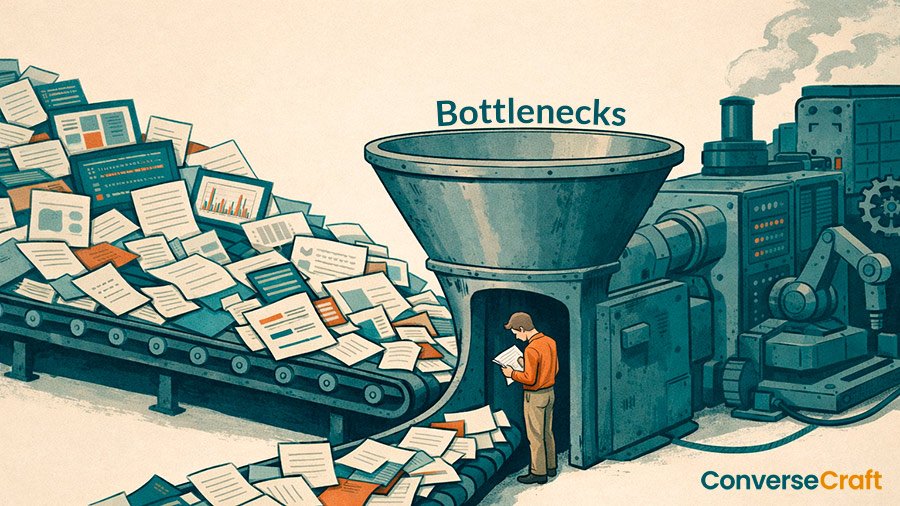
We keep talking about artificial intelligence as if it were the core of the problem. As if everything came down to which tool to use, which model to choose, or how advanced the technology is.
But that’s not where things get stuck.
Listening to Tyler Cowen↗, we find a simple idea most people insist on overlooking: when something becomes abundant, it stops being the bottleneck.
And today, AI is abundant.
Answers, texts, ideas, proposals, code, analysis — there’s no shortage of them. They’re one click away, faster, cheaper, and more accessible every day.
If all of this is available, then let’s stop treating it as the problem. The problem shifts.
AI Doesn’t Think
This newsletter made that clear from the start — even in its name — because many confusions begin right here: AI doesn’t understand what it does, it doesn’t reason, it doesn’t decide. It works well when someone has thought beforehand; it works poorly when left on its own.
That’s why I said — and still say — that AI, the Mule is the right way to think about it. Not as an insult, but as a functional description: a strong, patient, useful tool… that goes nowhere without guidance.
This matters, because if AI doesn’t think, someone has to. And that someone isn’t automatic.
The Myth of “Recovered Time”
Another repeated promise is that AI came to give you your time back. As if the time you save would remain free, untouched, waiting to be enjoyed.
In practice, something else happens: the time you don’t use, someone else uses better. AI doesn’t create leisure. It creates competition.
Technology speeds up tasks, yes. But the space it leaves behind fills up quickly: with higher expectations, more comparison, more pressure to decide well.
It Didn’t Come to Calm You Down
Neither did it. Saying that AI didn’t come to replace you is comforting… and dangerous, because it disarms you.
Your role doesn’t have to disappear for something to replace you. It’s enough that part of what you used to do no longer needs you.
History is full of examples: machines don’t eliminate work, they shift it. Tasks change, roles change, the points where value is added change.
That’s true today for people who write, manage, sell, coordinate, or make decisions.
AI didn’t come to leave you unemployed — but it also won’t let you keep working the same way, nor will it guarantee your relevance.
The Bottleneck
Cowen’s idea may make you uncomfortable — and it may help you:
- If AI produces answers and frames questions
- If it generates options and evaluates them
- If it accelerates processes and suggests priorities
But if it does all this using a general, reusable, statistical criterion — the same one available to you and to your competitor — is there a tie? Is competition over?
This is where the bottleneck appears. And if it’s still not clear: it’s not your problem. It’s your opportunity.
When companies use the same AI, the difference won’t be in using AI, but in when to use it, how to use it, and why.
Technology creates the tie. A person breaks it. The bottleneck is where we’re still needed.
This knot calls for:
- deciding which problems are worth solving — and which aren’t
- choosing which answer to use and which to discard
- integrating what AI suggests into real action
- taking responsibility for execution
- holding a criterion when everything invites you to change it (or the opposite)
None of this can be automated, because what’s required isn’t computing power but being in the real world, responding based on perception, and taking responsibility for the decisions we make.
Thanks to AI, answers, texts, and proposals become abundant — everyone knows that. The next step is realizing that, precisely because of this, the person or organization that decides, integrates, and assumes consequences stops being replaceable.
It becomes necessary. And valuable.
What’s Next
So far, everything I’ve published has looked at this phenomenon from different angles: the illusion of intelligence, the promise of recovered time, the fear of replacement.
What comes next is going one step further:
- Looking straight at where decisions get stuck today
- Why many companies buy technology and stay the same
- And why, even with AI running at full speed, some responsibilities don’t disappear — they concentrate
Not to scare you. Not to reassure you. But to understand where human work still is — and why that’s where the difference is made.
If you are considering concrete decisions or situations in your company, here is a piece focused on how they are defined and handled in practice.
Where the Bottleneck Moves When AI Is No Longer the Constraint →