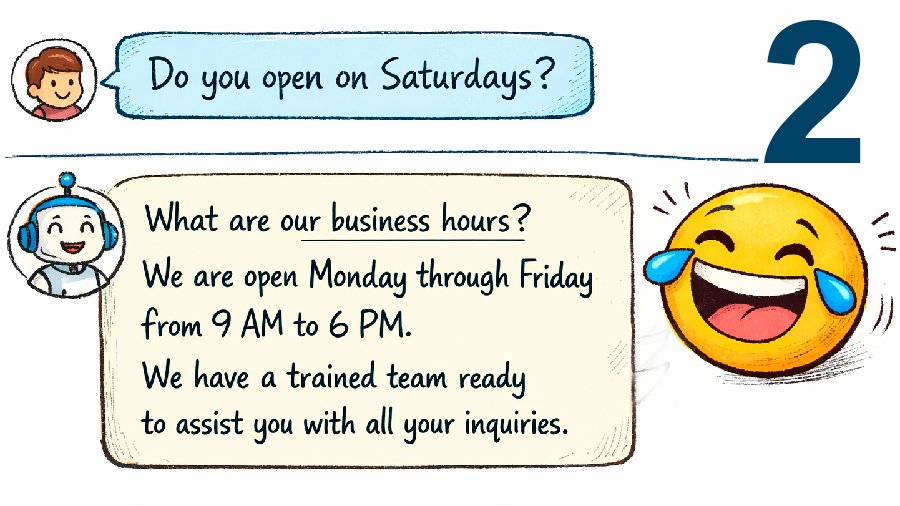
In the previous issue we talked about a common problem: an assistant that does answer, but doesn’t really follow the thread of the conversation.
Now let’s look at how to avoid that. This isn’t something you’re expected to do yourself. I’m sharing part of how I work so you can build your own criteria when deciding what to do about it.
First rule: one thing at a time
If we train an assistant with texts that:
- explain
- ask questions
- give examples
- sell
- warn
all mixed together… we shouldn’t expect clear answers.
Information needs order. And a good starting point is to separate:
- what is solid information
- what is context
- what is just a way of talking to the customer
When everything sits at the same level, the assistant doesn’t know what to use first. (This probably happens to you in other areas too.)
Second rule: watch out for internal questions
Many business texts include questions like:
- “Did you know that…?”
- “What happens if…?”
- “What are the benefits of…?”
They work well in a brochure or a training session, but they work poorly inside an assistant. Why? Because the assistant may try to answer those questions—even when the customer asked something else.
The result usually looks like this:
- it goes off on a tangent
- it repeats explanations
- it shifts the focus
When a question doesn’t add new information, it’s better to turn it into a statement.
Third rule: define the role of each text
Before loading any content, it’s worth asking:
Is this meant to inform, to guide, or to set the tone?
If we’re not clear about that, the assistant won’t be either.
A text that exists only to convey tone shouldn’t compete with one that contains key facts. An example shouldn’t carry the same weight as a rule. This internal order is what makes answers come out clean.
Fourth rule: less can be better
This isn’t about loading “everything, just in case”.
Every new text adds context—but it also adds noise.
An effective assistant isn’t the one that knows the most. It’s the one that knows what to use at the right moment.
What you get when it’s done right
When the content is properly prepared:
- the assistant goes straight to the point
- doesn’t repeat the obvious
- doesn’t change the subject
- and supports the conversation instead of getting in the way
In the end, it’s not that the technology became smarter. It’s that we educated it better.
And that’s real value for your business.
If you are considering concrete decisions or situations in your company, here is a piece focused on how they are defined and handled in practice.
Assistants that drift off: the problem isn’t AI, it’s the lack of conversational decision criteria →