AI didn’t come to replace you. It came to give you back your time.
The phrase left hanging from the previous issue sounds reassuring. But, like any statement that reassures too much, it’s worth examining.
the replacement
Saying AI didn’t come to replace you sounds kind, almost like a hug. But it’s also an elegant way to deny that something has changed. You don’t have to be fired to be replaced: replacement begins when part of what you used to do no longer needs you.
the machine
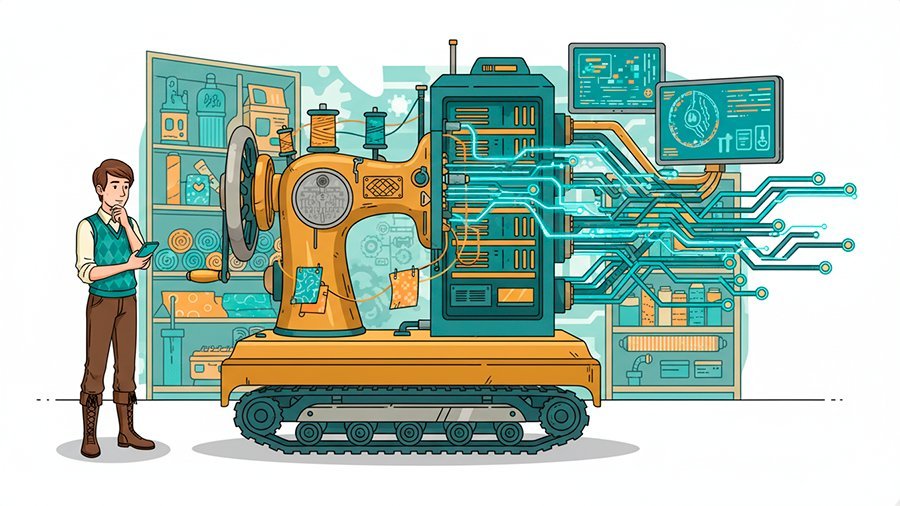
In 1830, tailor and inventor Barthélemy Thimonnier patented the first sewing machine. Eleven years later, he ran a workshop with 80 of his machines producing uniforms for the French army. But one night, a group of tailors stormed the place, destroyed the machines, and forced him to flee Paris. They feared the machine would take away their jobs.
prosperity
After the sewing machine, the way clothing was made changed. Some learned to work with the new tool and prospered. Others longed for the time when they felt more secure. The fact is that, after the invention, there were more people working in garment production than before.
Sewing machines multiplied sewing itself. Where once only a few made clothes by hand, many more could now produce them by machine. More clothes were made, more fabric was sold, prices dropped, and workshops and whole industries were born.
movement
To say AI didn’t come to replace you in a context that implies don’t worry, your job is safe is as false as claiming that AI will bring mass unemployment. It’s true: you might lose that job, that position. But for centuries, what has kept happening is not the disappearance of work, but its displacement. Roles change, tasks change… and people are still needed to fill the new ones.
It happened with tailors, linotypists, telephone operators, candle makers. And now it’s happening to those of us who write, design, program, or serve clients: with AI, we don’t stop working — we work differently.
imposition
Every technological leap displaces some and creates new experts. Those who quickly learn how to use the tool thrive. Those who expect everything to stay the same, suffer. The imposition brought by AI is not you will be replaced, but you will have to figure out how I can help you.
the move
Saying AI didn’t come to replace you is a comfortable way of doing nothing. Saying it will take your job is another comfortable way of avoiding adaptation. The truth is, it came to move you. The player who moves first plays white; the one who moves second plays black. Those who don’t move, don’t play.
the machine (again)
Duolingo’s employees aren’t storming OpenAI’s servers. But the story won’t be that different: resistance to the machine will stage campaigns, demand regulations, slow down the impulse. And the machine? The machine will keep moving.
If you are considering concrete decisions or situations in your company, here is a piece focused on how they are defined and handled in practice.
AI Doesn’t Replace You All at Once. It Starts by Hollowing Out the Work →