When the assistant fails to follow the conversation
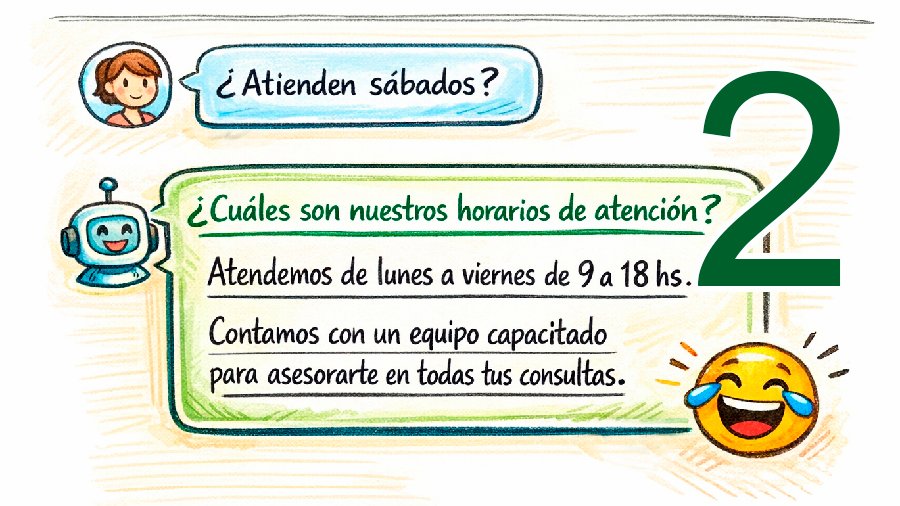
A client asks a specific question and the assistant responds immediately with valid information… but not exactly what was asked. It expands unnecessarily, mixes topics, or shifts focus mid-response.
This is not an obvious error. It is more problematic: the answer appears correct, but it is not useful. The conversation loses direction.
This pattern shows up even in recent implementations with current models. And when the root cause is examined, the issue is rarely the technology. It lies in how the material is structured and brought into the conversation.
The problem: everything competes at the same level
In many implementations, content is loaded as an accumulated set:
- product descriptions
- marketing copy
- FAQs
- internal examples
- training materials
Everything coexists without a clear reference to determine what is central in each situation and what is not.
A person can read that set and mentally organize what applies to each case. A system cannot. Without a way to interpret the conversational context and prioritize accordingly, any fragment can surface as a possible answer.
That is why responses are rarely “wrong.” They are partial, disorganized, or off-focus.
Signals that the problem isn’t the AI
There are recurring symptoms:
- it answers something related, but not what was asked
- it brings back questions embedded in the loaded material
- it adds general explanations even when they do not apply
- it mixes commercial arguments with operational information
In these cases, the common reaction is to adjust tone or add more content. The result is usually worse: more information available, but still no clear criterion for deciding when to use each piece.
Judgment and logic for handling business operations. Whether you are facing a concrete operational friction or simply exploring possibilities, input a real work scenario and take it from there.
Analyze your case →What changes when there is a criterion for using content
The difference is not adding more information or “organizing it better” in isolation. The key is whether there is a way to interpret the situation and decide, in each response, which part of the material should be used and which should not.
When that logic is present:
- what matters appears when it should, not before or after
- examples do not displace rules
- tone does not interfere with what needs to be said
- each response is built based on the situation, not on the available material
In that context, the assistant does not depend on finding “the right text,” but on maintaining a line of judgment throughout the conversation.
Less content is not enough without a criterion
Reducing content can lower noise, but it does not solve the underlying issue. If the system lacks a way to decide what to use based on context, even a smaller set of information can still produce off-focus answers. The problem is not how much content exists, but how it is brought into play in each response.
What outcome should be expected
When there is a clear criterion for interpreting each situation:
- answers go straight to the point
- unnecessary deviations disappear
- the conversation maintains continuity
- the client does not need to restate the question
The assistant stops responding to isolated fragments and begins to sustain a directed conversation.
This shift does not depend on adopting a different model. It depends on how decisions are made before generating each response.