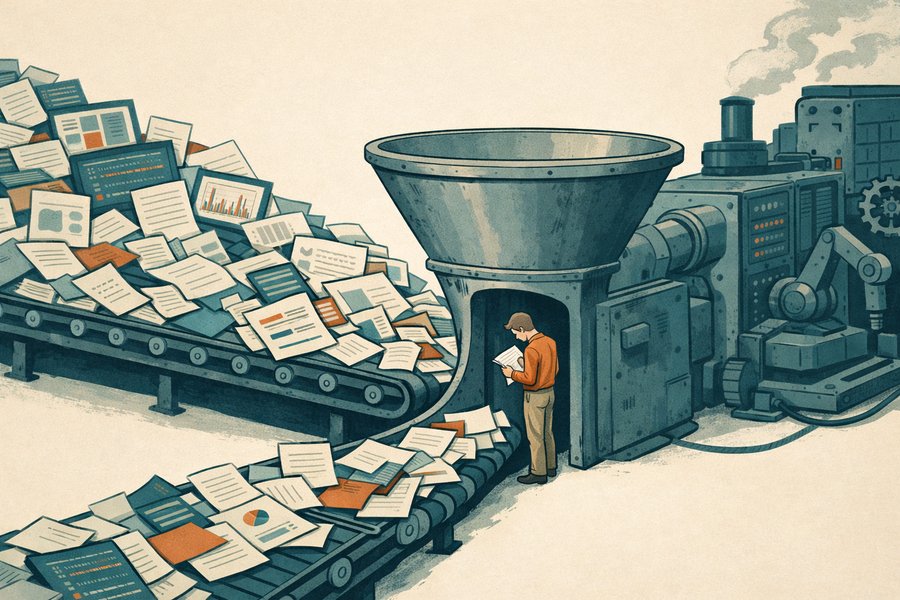
For years, the conversation around artificial intelligence revolved around the technology itself: which model to use, which system to adopt, how advanced the solution was. That discussion has lost relevance.
Following an idea raised by Tyler Cowen—when something becomes abundant, it stops being the constraint—the current situation becomes clearer: AI is no longer scarce. Responses, text, analysis, proposals, and automations are available, accessible, and increasingly fast to obtain.
Yet results across many companies remain mediocre.
When everyone has AI, no one stands out for having it
In practice, many organizations have already embedded AI across different functions:
- customer support
- content generation
- internal assistance
- commercial processes
But the pattern repeats: the system responds, but does not resolve. It completes the task, but does not improve the outcome. This happens because the technology operates on generic criteria. It produces plausible responses, but not necessarily appropriate ones for a specific situation.
When multiple companies rely on similar systems, that underlying logic becomes homogenized. The result is operational parity: everyone can do roughly the same, with similar outputs. Differentiation no longer comes from the ability to generate responses.
Where things begin to break
The issue appears in a less visible layer: before the response itself.
- what problem is actually being addressed
- what information matters and what does not
- what intent sits behind a request
- what to do with what the system produces
At this level, most implementations fail. Not due to lack of data or limitations in models from OpenAI or Anthropic, but because there is no defined structure organizing interpretation. The system reacts the same way to different situations, or differently to situations that should be treated consistently. This disorder is not technical. It is structural.
The illusion of automating decisions
A common implicit assumption emerges: if AI can generate answers, it can also decide. In practice, this does not hold.
Large models generate options based on patterns. They do not understand the real context where those responses are applied, nor do they assume consequences. When they operate without a defined interpretive structure, inconsistencies appear:
- correct answers in the wrong context
- reasonable decisions that do not apply to the case
- processes that scale errors instead of resolving them
The result is not efficiency, but loss of control.
The new constraint
If generating responses is abundant, the constraint shifts elsewhere—toward the ability to:
- define which problems are worth solving
- interpret a specific situation correctly
- decide when to use what AI proposes and when not to
- maintain consistent judgment across a process or interaction
- assume the impact of each decision
This is not resolved by access to technology. This is where value concentrates—and where many implementations fall short.
Why many companies use AI but remain unchanged
It is common to find organizations that have already invested in systems, integrations, or assistants, yet see no meaningful improvement.
The issue is rarely whether they chose Claude or GPT, or whether the model is premium or cost-efficient. The issue precedes that choice: the layer using Gemini or DeepSeek was built to respond, not to interpret.
Without a structure that defines how situations are understood, what decisions are made before responding, and how coherence is maintained over time, AI is reduced to producing text.
And producing text is not the same as solving problems.
Judgment and logic for handling business operations. Whether you are facing a concrete operational friction or simply exploring possibilities, input a real work scenario and take it from there.
Analyze your case →What actually differentiates an implementation
Once technology is no longer the limiting factor, differentiation does not come from “using AI.” It comes from how its use is structured.
Implementations that generate impact share one characteristic: they do not delegate judgment to the model.
That judgment is intentionally designed and defines:
- how each interaction is interpreted
- which decisions are valid in each context
- how a response connects to real-world action
AI operates within that framework. It does not replace it.
The shift many companies have not made
The conversation remains centered on capabilities—what AI can do. But the constraint is no longer there.
The critical point now is different: how decisions are made about what AI produces.
Until that is addressed, adding more technology does not change outcomes. Because the constraint is no longer response generation, but the ability to interpret, integrate, and take responsibility for what those responses imply.
That is where differentiation happens.