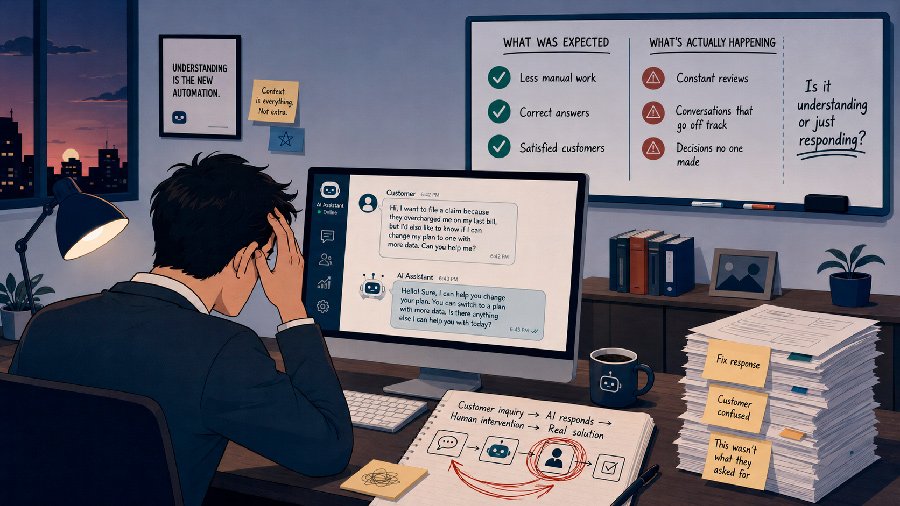
Many companies rely on AI every day, yet they still correct responses, lose time, and depend on human intervention. The issue is rarely the tool itself, but how context is interpreted and decisions are made within the conversation.
When AI Is There but Doesn’t Resolve Anything
In many companies, AI systems are already in place. Assistants handling inquiries, customer service flows, content generation, information analysis. From the outside, it looks like the problem is solved: the system responds, interacts, and produces outputs.
But when actual performance is examined, a different picture emerges: conversations that drift off course, customers receiving technically correct answers that are useless in their specific situation, teams stepping in manually because the system cannot distinguish which cases require judgment and which do not. Tasks that were supposedly automated still demand constant oversight.
AI is present. The expected impact is not.
The Problem Is Often Defined Incorrectly
In many cases, the discussion gets stuck on the tool: whether to switch models, refine prompts, or test another provider. Yet even with advanced models, behavior tends to degrade in the same places.
This happens because the problem is not the system’s ability to generate text. The issue appears earlier.
Most implementations start from an implicit assumption: that a conversation is just a sequence of questions and answers. As a result, entire human processes are mapped onto a probabilistic system that has no defined way to interpret ambiguity, recognize missing context, or decide between competing paths. This is where deviations begin.
An incomplete query receives a definitive answer. A customer mixes two separate issues and the system selects only one. A commercial exchange keeps advancing when it should pause to request clarification. The system responds, but it does not understand what is happening. It does not interpret the situation.
Where the Logic Breaks
For a person, these situations are often obvious. Someone on the team quickly detects when a customer is confused, when a response may create downstream issues, or when a conversation should escalate. Not because they have more information, but because they interpret intent, context, and consequence simultaneously.
Most systems are not designed to operate this way. They are designed to respond. And responding is not the same as deciding how to act within a real conversation. This is why many companies feel AI “works halfway”: the system can produce a perfectly written message and still worsen the situation because the prior decision was wrong.
The Cost Appears Later
These failures are not always visible at first. In early tests, the system seems useful: it responds quickly, automates tasks, and reduces operational load. The deterioration appears later, accumulated across hundreds of small misinterpretations:
- customers receiving confusing information
- teams constantly correcting outputs
- decisions based on incomplete context
- gradual loss of trust in the system
In many cases, the conclusion becomes that “AI is not ready” for the business, even though the limitation was not necessarily in the technology.
Judgment and logic for handling business operations. Whether you are facing a concrete operational friction or simply exploring possibilities, input a real work scenario and take it from there.
Analyze your case →The Limit of Continuous Experimentation
Many companies get stuck in a permanent adjustment phase. They switch models, rewrite instructions, add new automations, and test different configurations. But the underlying behavior does not change, because the system still operates without a clear logic for interpreting real situations.
This usually happens for a simple reason: defining how a system should behave in ambiguous conversations requires time, analysis, and a conceptual structure that often does not exist internally.
And progress continues anyway, built on a foundation that is still unresolved.
What Changes When the Focus Shifts Away from the Response
Implementations that work consistently start from a different premise. Conversation is no longer treated as text generation, but as a problem of interpretation and decision-making. The key question is no longer just what to say, but how to determine what is happening before saying anything.
This fundamentally changes system behavior. It becomes relevant whether the query is incomplete, whether the user misunderstood a condition, whether contradictions exist in prior exchanges, or whether the situation requires human intervention before proceeding.
The model stops acting as a standalone response generator and becomes part of a conversational architecture designed to interpret context and sustain judgment throughout the interaction. This is where more consistent outcomes emerge, even when using models that are not the most expensive or the most recent.
Why the Problem Rarely Appears from a General View
One reason this issue persists is that, from the outside, the system appears to work. High-level metrics may look acceptable, responses are fast, conversations progress, and automation is visible.
The deterioration occurs in specific cases: a response that derails a commercial decision, a misinterpretation in an ambiguous context, a conversation that should have taken a different path.
This is why the problem only becomes visible when someone reviews concrete situations and analyzes how the system arrived at a given response. At that point, it becomes clear that the issue was not lack of information, but lack of judgment in interpreting the situation.
What Separates the Cases That Actually Work
Companies that successfully integrate AI do not necessarily have more resources or better technology. The difference lies elsewhere.
In these cases, the problem is framed in terms of decisions and context, not just responses. Conversation is designed around real situations, including ambiguity, errors, interruptions, and criteria for intervention.
When this happens, AI stops behaving like an isolated experiment and starts integrating coherently into operations. Because the limitation was never the ability to generate text—the limitation was that the system responded without truly understanding the problem in front of it.